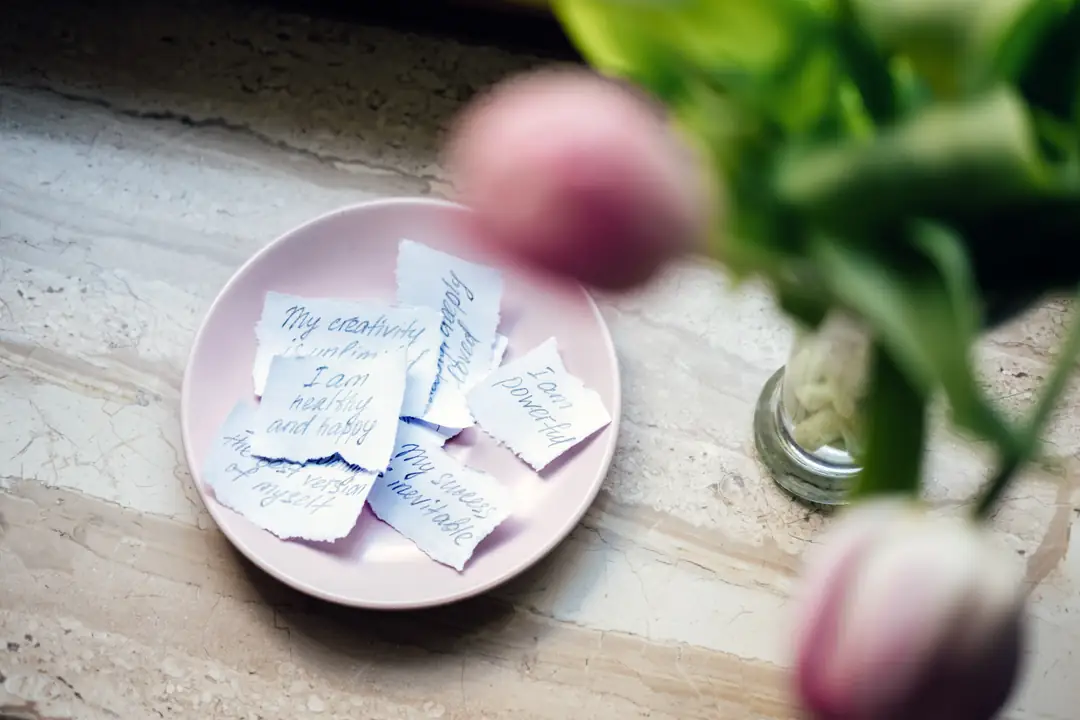

Four things want your attention and none of them will wait. The calming affirmations here are not written to switch that off, because nothing switches it off on command. They're for getting one hand on the wheel while it's still noisy.
What calming affirmations are actually for
Reducing the number of things you're managing at once. When your attention is scattered across four tabs and a phone face-down on the desk, one of the loudest voices is usually the one saying you shouldn't be like this. A good line removes that voice specifically, leaving you with the original problem instead of the problem plus your opinion of yourself.
Lines for when everything is talking at once
Read one slowly. Any of these can be true while your heart is still going.

I can do one of these things. The rest can wait ten minutes.

Being wound up is not evidence that I am failing.

My attention is scattered. I am still here.
An afternoon that will not pause
For the hours that won't wait for you to feel better before continuing.

I can work badly for an hour and still finish this.

Nobody needs me to be calm. They need me to answer.

Half of this list can move to Thursday.
For right before you have to speak
The call in four minutes, the room you are about to walk into, the message you have to send now.

I can say this badly and still be understood.

My hands are shaking. My sentences still work.

Nobody in this room is grading me.
When it has passed and you are still shaky
The difficult thing ended twenty minutes ago and your body has not been told.

This will pass without me forcing it to.

My body is finishing something. It is not starting something.

I do not have to review how that went right now.
Why telling yourself to calm down backfires
Everyone has been told to calm down by someone else, and everyone knows how well it lands. The version you say to yourself works the same way.
Picture the actual moment. It's twenty past three, there are eleven unread messages, someone is waiting on a reply you haven't started, and your coffee went cold an hour ago. Into that you drop the instruction to relax.
A sentence like "I am completely relaxed" sets a standard and then invites you to check yourself against it. You do check. You fail. Now there are two problems: the original one, and the fact that you can't manage the simple instruction.
A 2009 experiment found something close to this in the lab. People repeating a strongly positive statement about themselves came out worse than people who said nothing, if they were already low on confidence. The statement gave them something to disagree with.
So the lines above never declare a state. They describe permission, or a next move, or something plainly true. You can't fail any of them in the next thirty seconds, and that's the property that matters when you're already wound up.
Wording that survives the moment
The pattern is consistent once you see it. Take the state out of the sentence and leave the permission in.
I am calm and centred.
Checkable, and currently false.
I do not have to be calm to handle the next bit.
Removes the entry requirement.
I release all tension from my body.
Releasing is not an action you can take on request.
My shoulders can stay tight while I answer this email.
Lets the body do what it's doing.
Everything is under control.
Contradicted by the reason you're reading this.
Some of this is mine to sort out, and some of it is not.
True, and it narrows the pile.
Where to put the line so you actually reach it
Choosing a good sentence is the easy half. Most people fail at the second half, which is finding it again at the moment they need it.
Saved notes rarely get opened when your attention is jumping, because opening the phone puts you one tap from everything that wound you up. Paper does better. So does anything already in your line of sight.
- Written on a card and left where you sit down, not in a drawer.
- Attached to a moment you always pass through, like filling the kettle or sitting back down after standing up.
- One line, not a list. Scanning a list is itself a small task, and you have enough of those.
If a line stops landing after a couple of weeks, swap it rather than adding another. The usual reason is that the situation moved and the sentence stayed where it was.
I can be unsettled and still be reliable.
A line to return to
Keep expectations realistic
A line can interrupt the loop where being wound up becomes proof that something is wrong with you. It cannot lower your heart rate on command, remove whatever caused the state, or work as a treatment. Relaxation approaches are generally considered safe for healthy people, though it's worth knowing that a minority report the opposite effect: more anxiety, or thoughts arriving rather than settling. If that happens to you, stopping is a sensible response and not a failure. And if this state is arriving most days, or getting in the way of sleep, work or the people around you, that belongs with a professional rather than with a better sentence.
Sources and further reading
These references support the research and practical guidance discussed in this article.
- Relaxation Techniques: What You Need To KnowNCCIH. States that relaxation techniques are generally considered safe for healthy people, and that some people report negative experiences such as increased anxiety or intrusive thoughts. Both halves of that are used on this page.
- Positive self-statements: power for some, peril for othersWood, Perunovic and Lee, Psychological Science, 2009. Repeating a strongly positive statement left participants with low self-esteem feeling worse. Why none of the lines here declare you calm.
- Self-affirmations can boost well-being: a meta-analysis of 67 studiesZhang, Chen, Hu and Wang, American Psychologist, 2025. The measured effect across more than 17,700 participants was real and small, which is the size of promise this page keeps to.