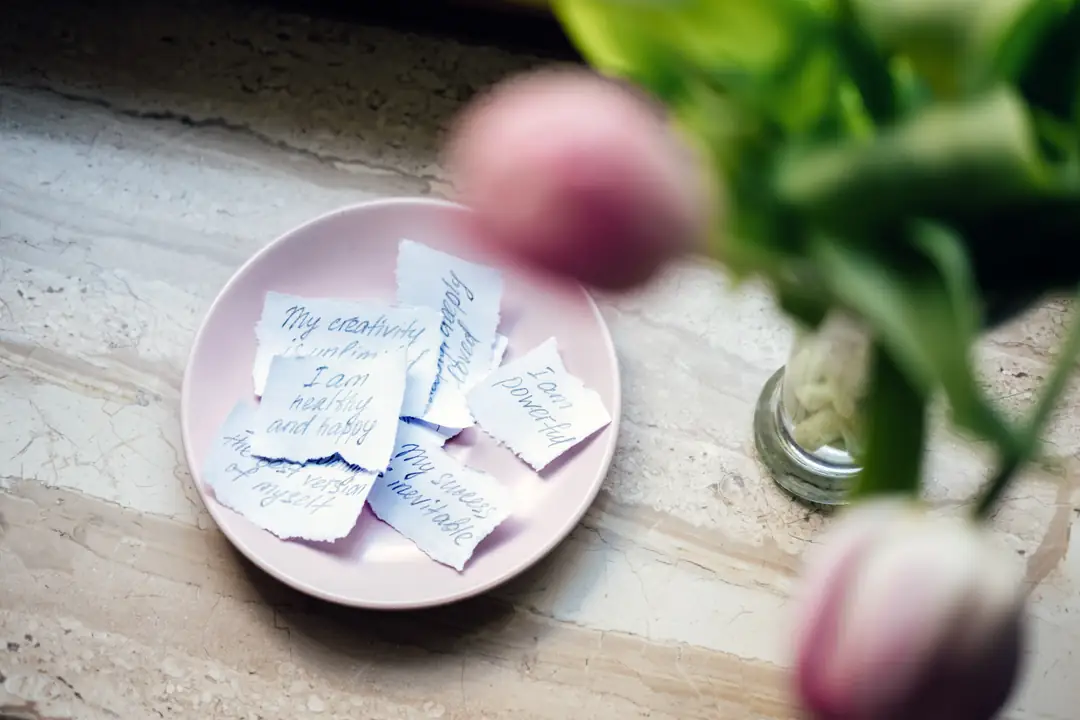

It's late and the day is still running. Not a crisis: a conversation you keep re-hearing, a list for tomorrow that won't stay shut. The sleep affirmations below are for that hour. None of them will put you to sleep, and any page claiming otherwise is selling something.
What sleep affirmations actually do at this hour
They give you something to answer a thought with, so you stop following each one all the way to the end. Research on relaxation methods for chronic insomnia is small and low in quality, and the sleep guidelines treat relaxation on its own as a conditional option rather than a treatment. Use these to stop arguing with yourself at midnight. Expect nothing beyond that.
Lines for a day that won't close
For the first stretch, when the thinking still feels useful and you're almost convinced you're solving something.

Today is done. I do not have to decide anything now.

This can wait until I am awake enough to do it well.

Nothing I settle at this hour will survive the morning.

I am allowed to stop thinking about this now.
When you keep replaying a conversation
The second hour usually belongs to something someone said, or something you said back.

I can decide what to do about this at nine tomorrow.

Rehearsing it again will not change what was said.

I am allowed to be wrong about how it went.
For when you have been awake too long
By now the original worry has quietly been replaced by the worry about being awake. Different problem, different lines.

Lying here resting still counts for something.

I do not have to sleep well to get through tomorrow.

Tomorrow can be a smaller day than I planned.
Three in the morning
Everything is worse at three and better by seven. These are for the stretch where that is hard to believe.

This hour is not a reliable narrator.

Nothing about my life has changed since ten o'clock.

I will feel differently about this in daylight.
Why the thinking is the part that keeps you up
This is one of the few things here that's been measured directly. In a 2012 study, researchers deliberately raised participants' mental activity before bed, then recorded how long they took to fall asleep. It took longer. Their bodies were no more tired than usual. Their minds were still working.
So the thing to interrupt isn't tiredness. It's the habit of following a thought to its conclusion, then starting the next one. Most people lying awake aren't insufficiently relaxed. They're still doing something.
There's usually a second stage, and it's worse than the first. At some point the subject changes from whatever was bothering you to the fact that you're awake: how few hours are left, how bad tomorrow will be. The second group above is for that loop.
Lines that promise sleep, and lines that don't
Most collections of positive affirmations to sleep contain a promise somewhere. That's the part that turns a sentence into one more thing you're failing at by two in the morning.
I fall asleep easily and sleep deeply all night.
You're awake. The sentence is being disproved as you read it.
I can rest here even if sleep takes a while.
Still true at three in the morning, when you need it.
My mind is completely calm and quiet.
It isn't, and saying so makes the noise more noticeable.
My mind is busy, and I don't have to follow it.
Lets the thinking exist without joining in.
I release all worries from today.
Releasing isn't something you can do on command.
Today is done. I don't have to decide anything now.
Describes a permission rather than an act of will.
One way this may fit into a day
One evening I got into bed after a difficult day and realised I could not switch my head off. I kept replaying one conversation from work, thinking about what I should have said instead. Then I moved on to what was waiting tomorrow. I had been lying there about forty minutes. My body was tired, but inside it was still the working day. Even my jaw was tight.
I used a very plain line: "Today is done. I do not have to decide anything now." I repeated it every time I started turning a situation over again. At first nothing much changed. After a few minutes I noticed I was no longer catching on every thought. One would arrive, I would say the line, and it would sort of let go.
Some time after that my shoulders loosened and my breathing settled. I did not notice the moment I fell asleep. The next thing I remember is morning. I've used the same line on a few evenings since, and it does keep me from winding the thinking back up.
Resting is allowed to be the whole plan for tonight.
A line to return to
Where this stops being useful
A line at night can break the habit of chasing each thought, make the hour less unpleasant, and take some pressure off the night itself. It cannot treat insomnia, and it is no substitute for doing so. If you're sleeping badly most nights, or it's been going on for weeks, the treatment with real evidence behind it is cognitive behavioural therapy for insomnia. That's a conversation with a doctor rather than a longer list of sentences. The same applies if sleep got worse alongside pain, medication, or a period of low mood.
Sources and further reading
These references support the research and practical guidance discussed in this article.
- Psychological and Physical Approaches for Sleep Disorders: What the Science SaysNCCIH Clinical Digest, March 2024. The basis for describing the evidence on relaxation methods for chronic insomnia as small and low-quality rather than established.
- Behavioral and psychological treatments for chronic insomnia disorder in adults: an AASM clinical practice guidelineEdinger and colleagues, Journal of Clinical Sleep Medicine, 2021. Recommends multicomponent CBT-I strongly, and relaxation therapy alone only conditionally. Behind the point that a line is not a treatment for insomnia.
- The influence of pre-sleep cognitive arousal on sleep onset processesWuyts and colleagues, International Journal of Psychophysiology, 2012. Measured sleep onset after deliberately raising pre-sleep mental activity: it took longer. Supports the section on why the thinking is the part that keeps you awake.
- Positive self-statements: power for some, peril for othersWood, Perunovic and Lee, Psychological Science, 2009. People with low self-esteem who repeated a strongly positive line felt worse afterwards. Why every line here stays small.